
All the posts related to Rama and the Ramayana are tagged https://crackpot.substack.com/t/rama
Ill Illos
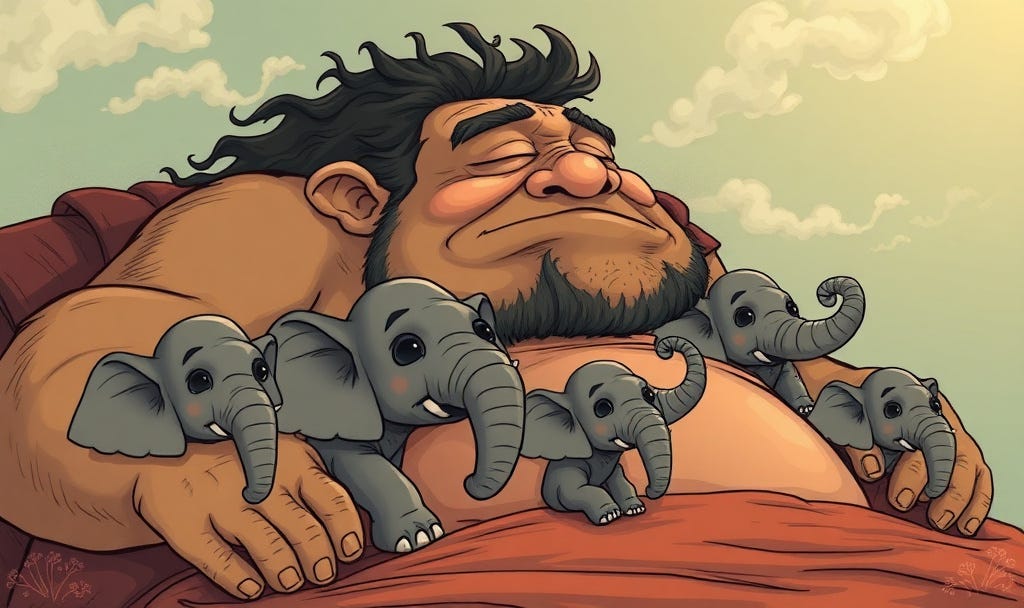
These scenes are drawn from the Mahabharata as translated by Manmatha Dutt. The Mahabharata retells the Ramayana an epic within the epic. These are the battles that follow from Sita’s abduction by Ravana and the slaughter of Rama’s eagle Jatayu.
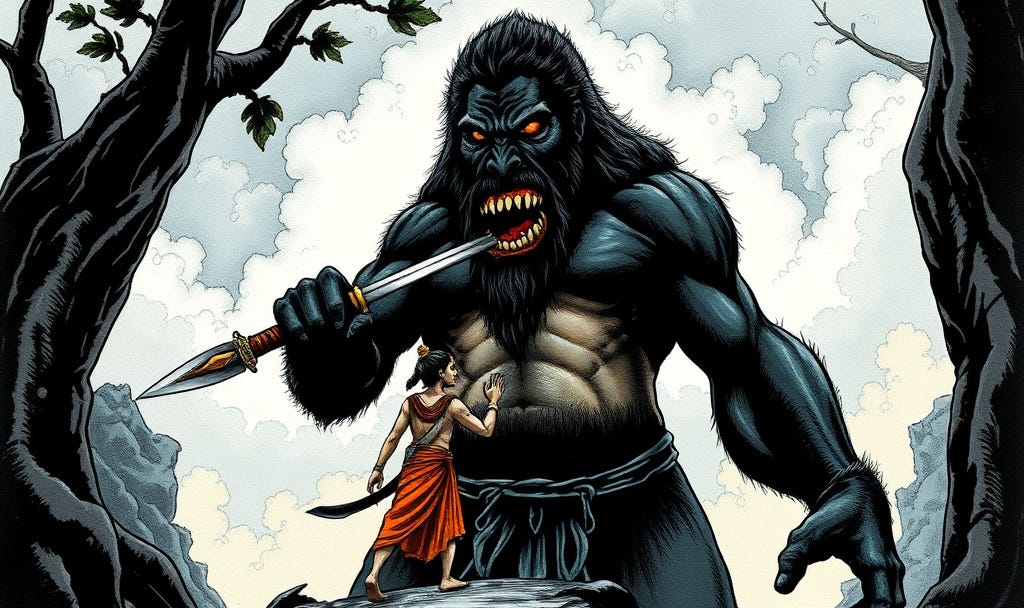
A cannibal appeared then who was dark as clouds and huge as a rock, with shoulders as broad as a tree, with gigantic arms, having large eyes on his breast and a mouth on his expansive belly. The cannibal seized Lakshmana with one arm, but Rama severed the cannibals hand with a sword before he could take a bite from Lakshmana’s skin. - Dutt. Ramopakhyana Parva. chapter 279
With his dying breath, this cannibal advises Rama to seek Shabari, who is an aged good souled woman of the woods. Shabari summons Hanuman. From there it is not long before Sita is found in Lanka.
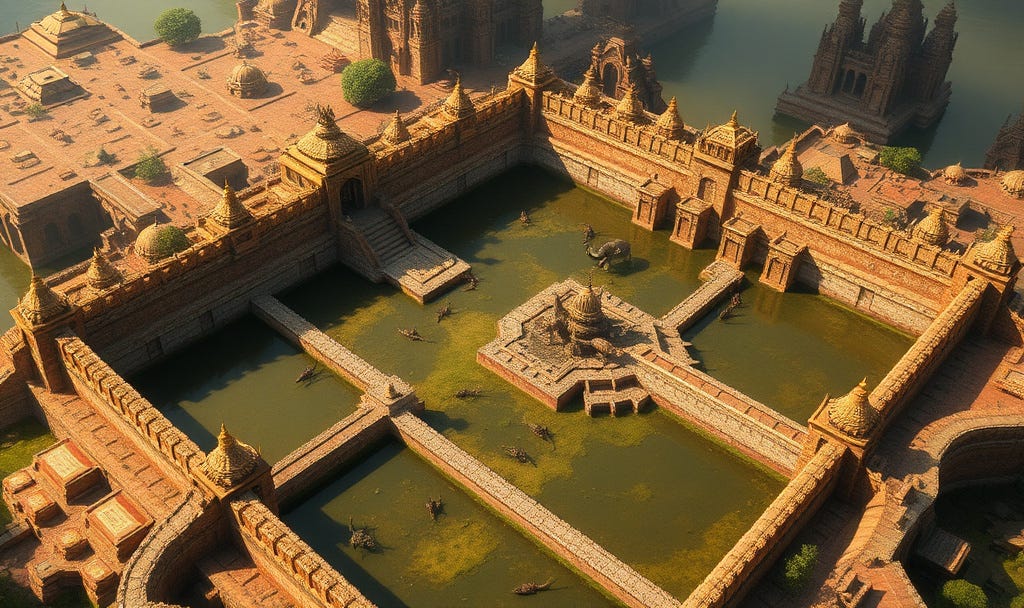
Ravana set up his defense of Lanka. The city had seven moats, each protected by walls and gates, whose waters were filled with carnivorous fish and alligators, and surrounded with pointed stakes. The ramparts were made of round stone and iron clubs. The warriors stationed had in their arsenal jars of poison snake (to drop down on those trying to climb the walls) and resins. They wielded maces, fire-brands, swords, axes and clubs dipped in wax. Innumerable horses and elephants guarded Lanka’s gates. - Dutt. Ramopakhyana Parva. chapter 284
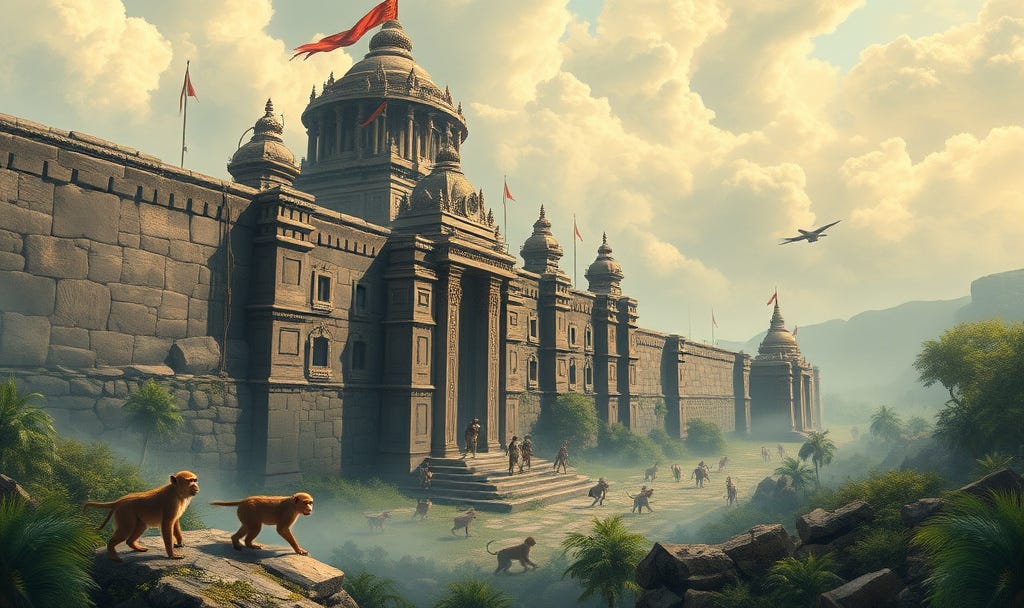
Angada led an army of monkeys to breech the walls of Lanka. The monkeys dismantled the walls, which were constructed at their tops by stones rudely placed without mortar. Lakshmana and Bibhishana and Jambuvana (lord of Bears) demolished the southern gate. Rama then invaded with thousands of apes. The monkeys and bears broke down pillars of gems and terraces and spires of palaces. They hurled stones, clubs and stones with loud yells. - Dutt. Ramopakhyana Parva. chapter 284
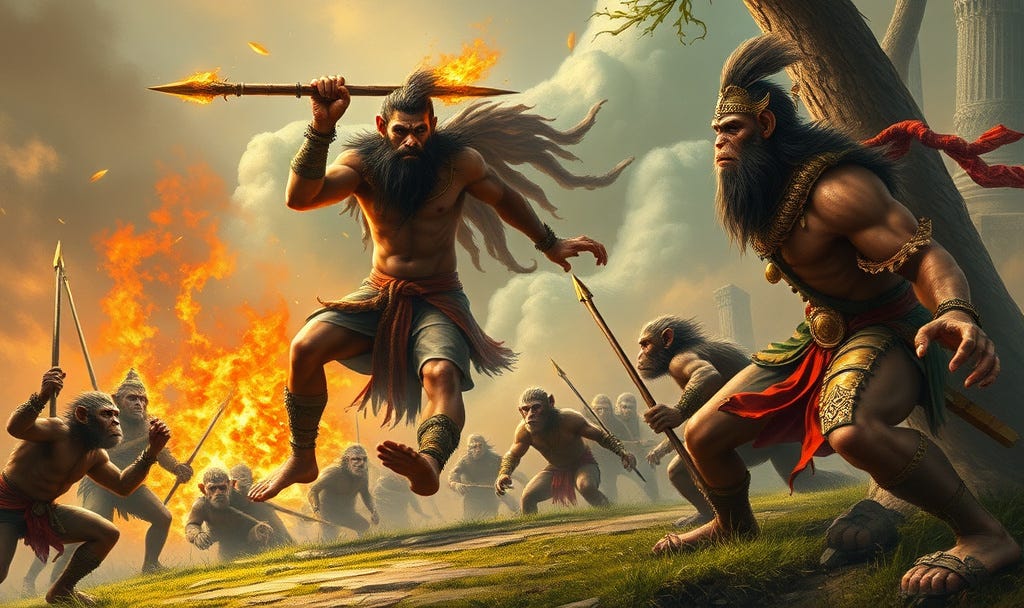
The ape warrior Vibhishana hurled a javelin studded with a hundred bells that sliced off the head of Prahasta, the cannibal lord. Hanuman killed Dhumraksha the cannibal with a club fashioned from a tree. Upon seeing these mighty cannibal generals fall, the monkeys lost all fear and rallied fiercely. - Dutt. Ramopakhyana Parva. chapter 286
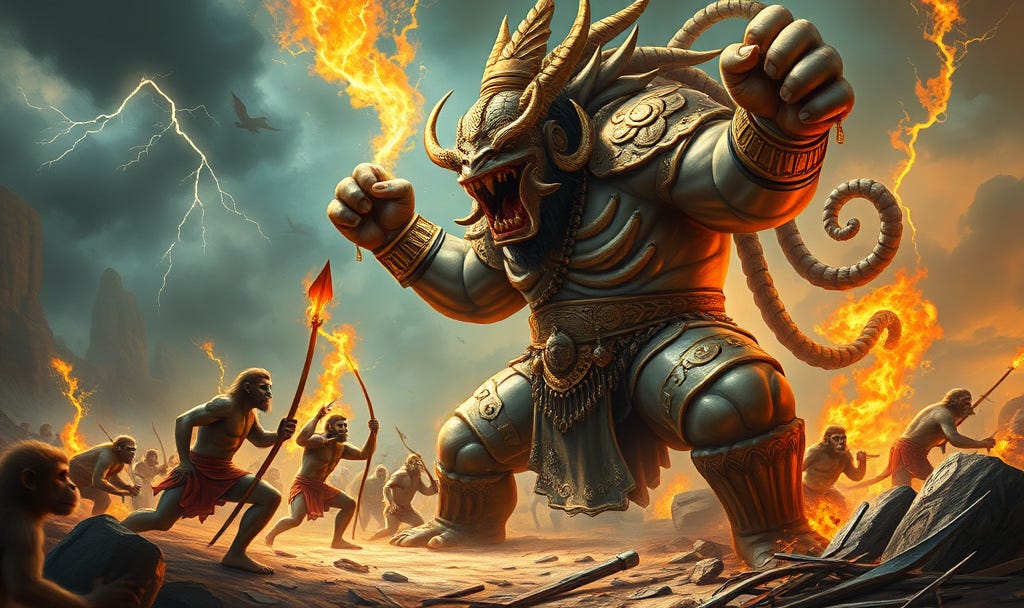
Ravana summoned his brother, the giant Kumbhakarna, to do battle. Kumbhakarna took the field of battle in Lanka and, upon seeing the monkeys running amok, seized the monkeys named Bala, Chandabala and Vajrabahu closest to him. Then Kumbhakarna slaughtered and devoured these monkeys. At this the Ape Lord named Sugriva rushed Kumbhakarna, but he was defeated. Sugriva was about to be devoured when Lakshmana pierced Kumbhakarna’s armor with a golden arrow. Kumbhakarna raised his arm to hurl a boulder at Lakshmana, but Lakshmana severed Kumbhakarna’s arms with razor sharp arrows. Kumbhakarna fells like a gigantic tree having its branches burnt by lightning. - Dutt. Ramopakhyana Parva. chapter 287
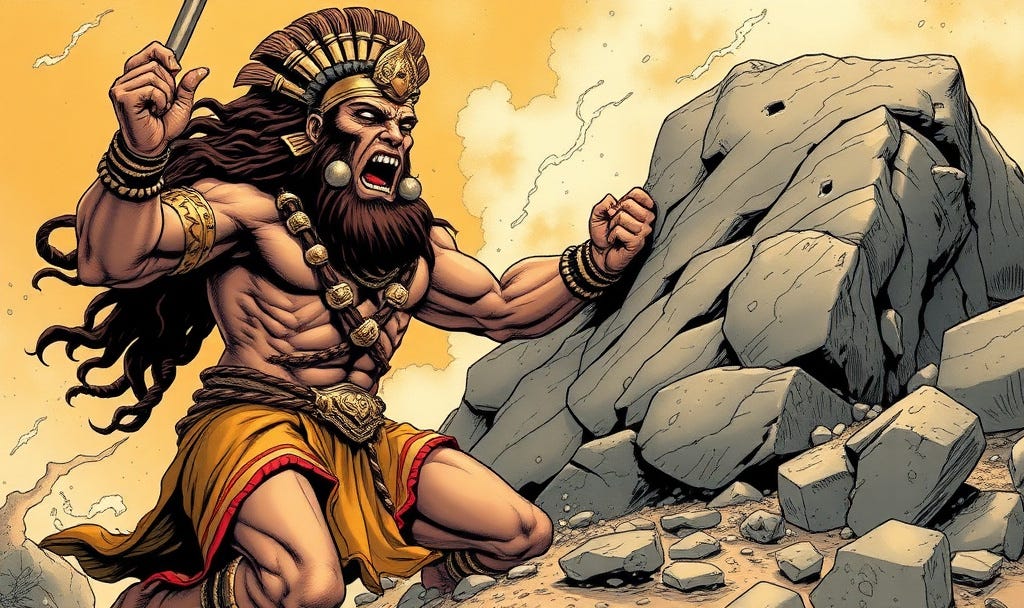
Hanuman crushed the cannibal Vajravega with a rock. - Dutt. Ramopakhyana Parva. chapter 287
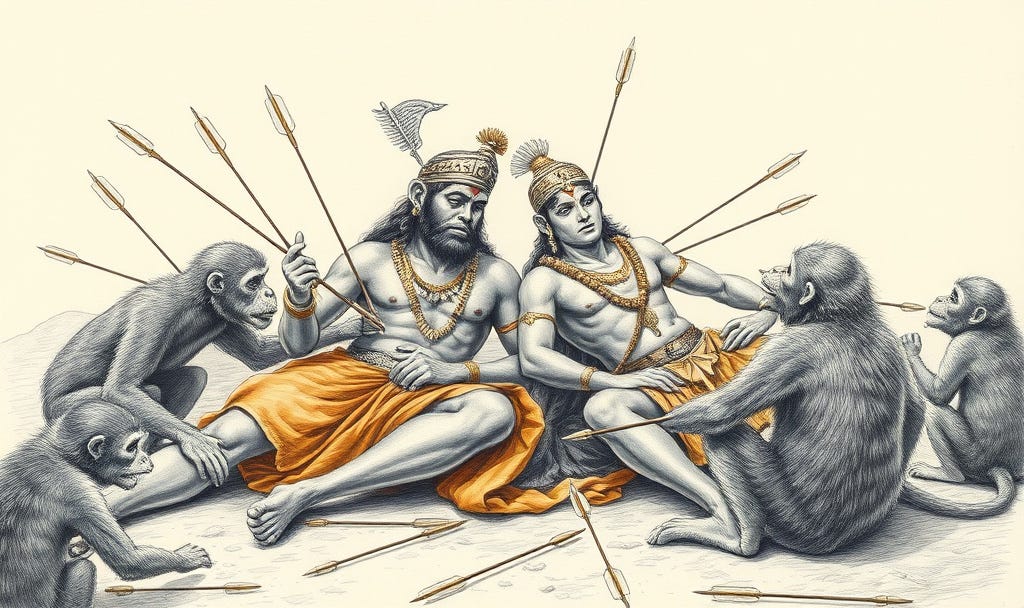
Ravana next dispatched his son Indrajit to defeat Rama. Indrajit was so named because he defeated the God Indra in battle. Indrajit defeats Rama and Lakshmana together. The monkeys and apes doctor their wounds with the restorative Vishalya medicine. Lakshmana rallies and defeats Indrajit, slicing off Indrajit’s head and arms with flaming arrows. - Dutt. Ramopakhyana Parva. chapter 289
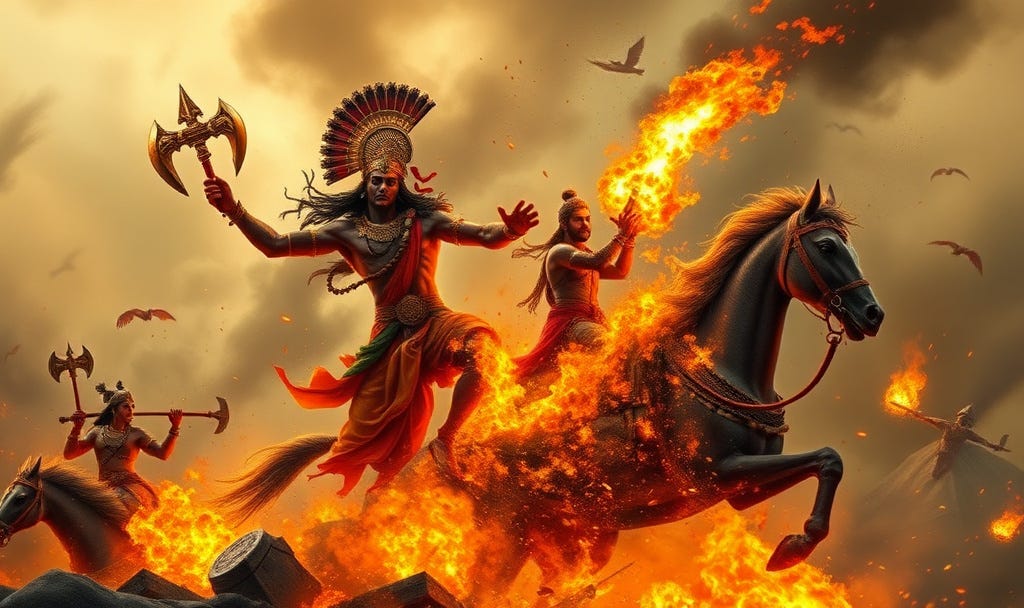
Indrajit’s empty chariot returns to Lanka. Ravana knows his son is slain. Ravana rides into battle on his chariot to face Rama. Ravana hurls a javelin that Rama slices down. Ravana hurls maces, axes, clubs, darts and arrows but none can find their mark. Rama had a powerful weapon. Upon discharging that missile Ravana and his chariot were enveloped in a blazing fire and burnt to ashes. Ravana was defeated. - Dutt. Ramopakhyana Parva. chapter 290
Many years later…
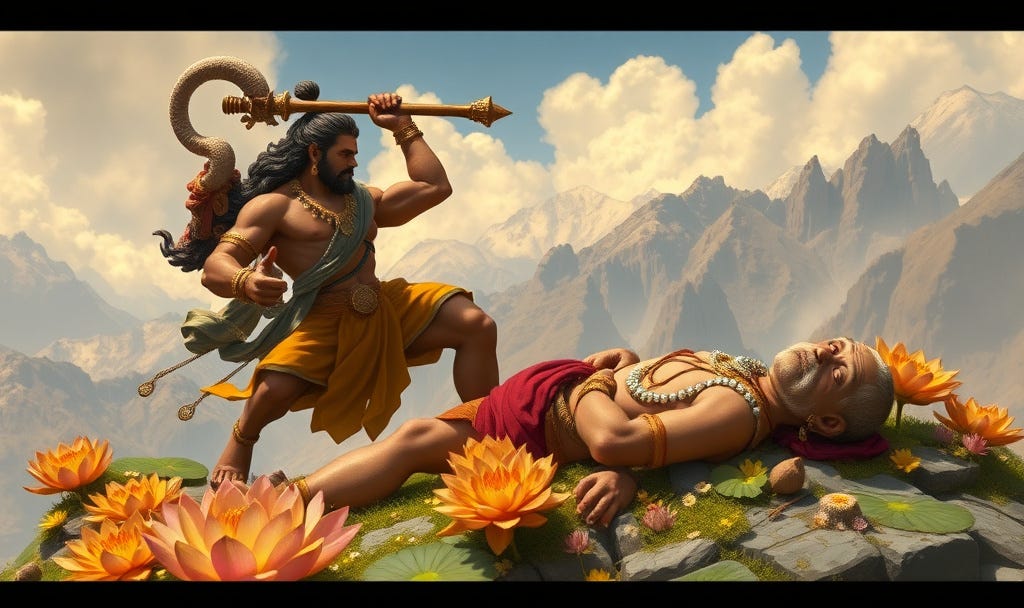
After Ravana’s defeat, Hanuman is given a boon to live for as long as Rama is known. One day, according to the Mahabharata, the aged Hanuman meets Bhimasena Pandava. At the time Bhima is gathering flowers for Draupadi. Bhima saw Hanuman’s head with small lips, a coppery face, long tongue, red ears, and silver hair laying conspicuously in his path. The two heroes argue at first. Bhima accepts Hanuman’s challenge to lift his tail and fails. Bewildered, Bhima makes fast friends with Hanuman. Bhima asks if Hanuman could have defeated Ravana. Hanuman proudly says he could have defeated Ravana, but that he purposely left Ravana for Rama.
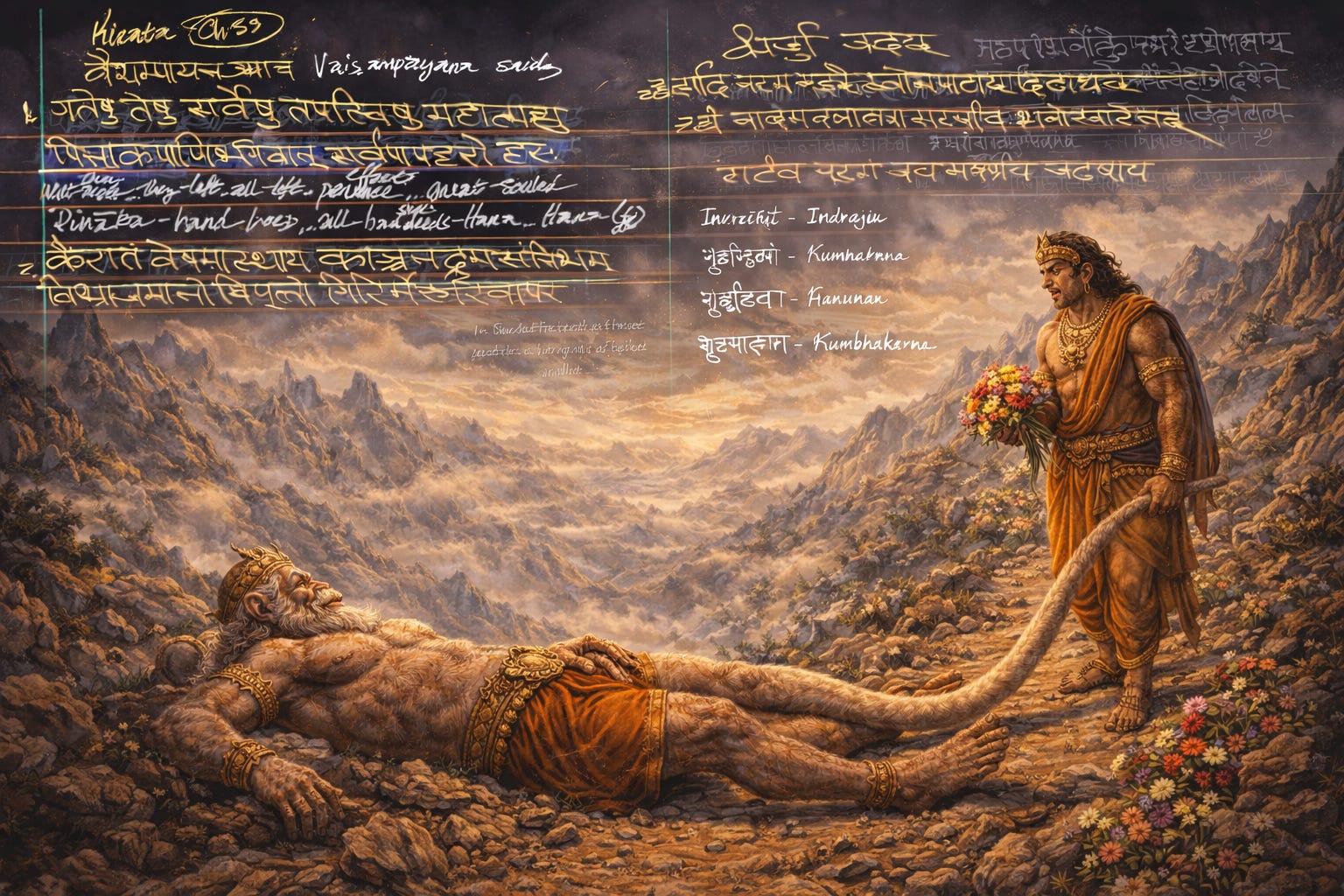
This whimsical episode of the Mahabharata makes some mortal sense within the timeline established by AK Mazumdar - whereby Rama preceded the Pandavas by a generation or so from, with the years 1460-1380 BC belonging to Rama first, then the Pandavas and Kauravas.
Rakshasas (cannibals)
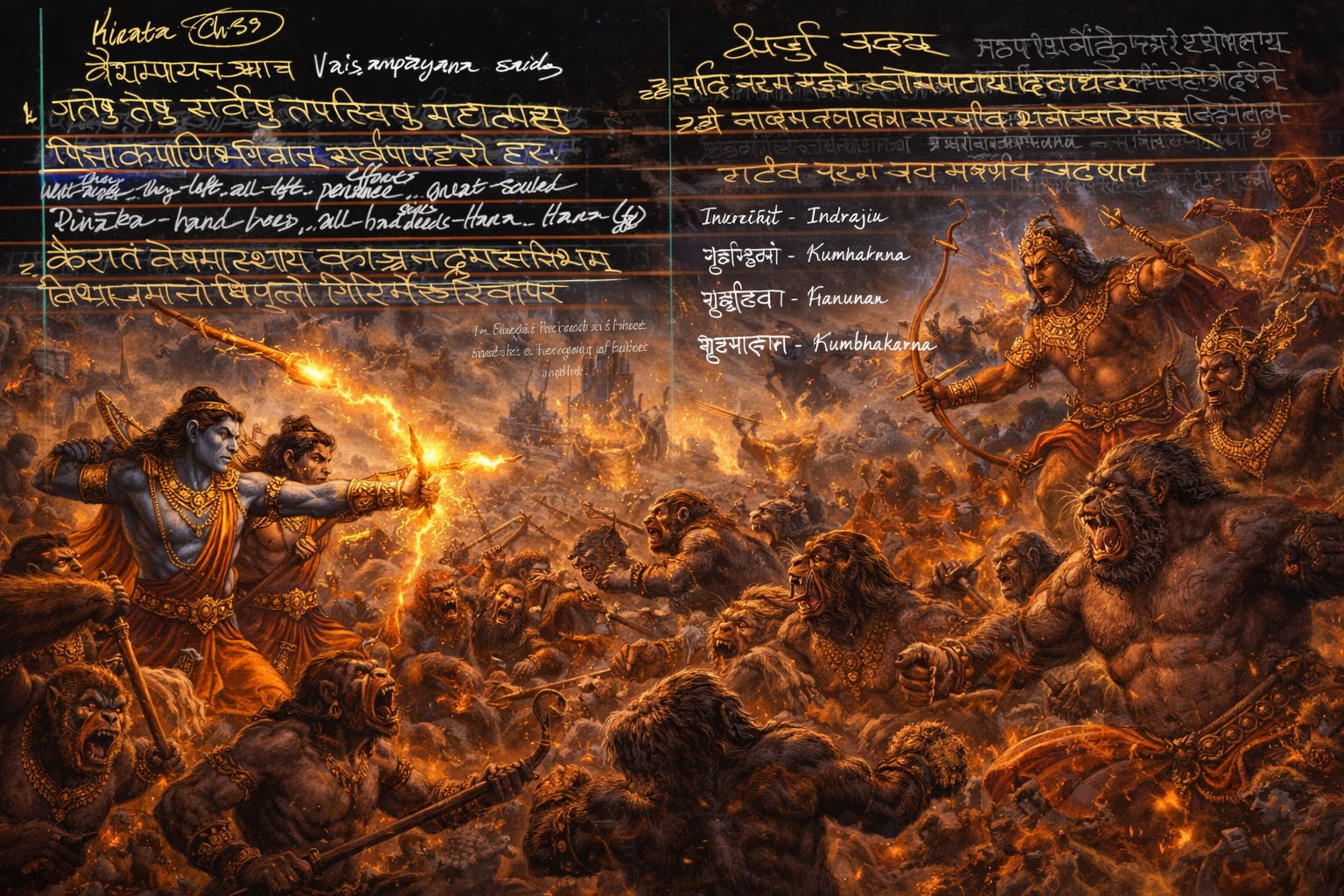
Human flesh eaters. On the mortal plane, cannibals. On the divine planes, demons incarnate in human form. Rakshasas are often ascribed extraordinarily large figure. To awake Kumbhakarna for his fight, they had elephants step on his chest. Rakshasas are also ascribed powers of maya, or the ability to manipulate conscious perceptions. This all may reflect the larger than life and power the hunters held over the hearts and minds of the hunted. A human that hunts humans for food, who use trickery and brute force to kill another human with the same mind as a human slaughtering a deer or pig would be a terrifying super-human force.
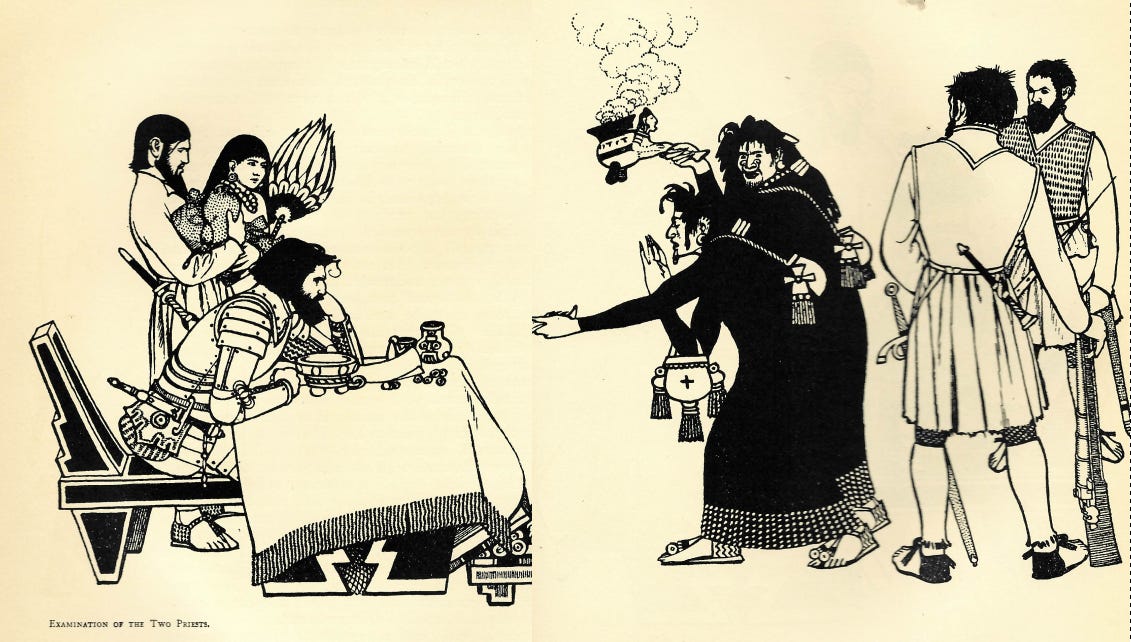
Prescott, William H, and Keith Henderson. History of the Conquest of Mexico. Vol. 1, Hearn Holt and Company, 1 Dec. 1922.
Accounts of cannibals in whatever historical context attribute to those beings dark blood stained nails, flesh and hair clotted stained with blood and smoke. Their rude living conditions in elements expose skin darkened by the sun - gives rise to some idea that racism has its roots in these origins. May be a cultural holdover from days long gone by - when dark skin might have been tells that you are being hunted. The Aryan invasion theory of India is largely debunked now with the realizations that the Aryans originated in the same place as the Dravidians - given the ecological realities during the drying of a once mighty Sarasvati river. Colonial history promoted racist terms - whereby in the past the light skinned Aryans came to India amidst the dark skinned Dravidians and civilized them - as the British, Scottish, Swedish, etc. Europeans through British colonialism as a light skinned race came in and civilized dark skinned brutes of which Mazumdar India. These theories run into the cold hard facts of the Sarasvati drying and lack any evidence to substantiate. They are as outdated as the Bering land bridge Ice Age thaw being the only line of emigration to North America before 1492.
Yugas
What is the turn of a Yuga? What happens then? Ideas wipe from the mind of man under stacks of civilized acts. Like a Ferris wheel, conditions under some set of ideas may oscillate between good and harsh through several cycles. The fourth spin culminates in the destruction of a demonic wellspring - whereupon some ideas are abolished (like monarchal dynasty) - and the process begins again on the next set of reduced tyrannies.
The slaying of Ravana marked the turn of the Yuga cycle from the 2nd to 3rd age, or Treta to Dvapara. The end of the Dvapara came a scant 100 years later by Mazumdar’s chronology, with the death of Krishna. The Treta lasted more than a millenia by the same reckoning, beginning with the slaying of Hiryankashakipu around 2800 BC. The 1st age, Krita, may have been from the end of the young Dryas to 2800 BC - a 10,000 year epoch! The change of the epochs are marked by the incarnations of Vishnu. Matsya is the first incarnation who took form in a great flood as a golden fish, similar to Gob and other central mythology, and makes the Young Dryas end of Ice Age a compelling starting point for the Krita. If the 4th age, Kali, the present age, is taken to have started after Krishna’s death, then the Kali yuga has been from then until now lasting 3,400 years and counting. At the end of Kali 4th age the cycle begins again with Krita, the 1st age. Supposedly there have been 8 full cycles from Krita-Treta-Dvapara-Kali in mankind’s history, each full cycle called an age of Manu. Various texts describe the number of years in each Yugic age differently. Some say hundreds, some thousands, some more. The number of calendar solar years does not math as divine years. Interpretation of such variance as numerical metaphor and that time as experienced on earth is relative not the same as time experienced on higher (non-material) planes where demonic and divine beings dwell.
The yugas proceed in a decline of dharma and rise in deviancy - though human suffering seems to hang the same in balance. In other words, the sufferings of the best age seem no less but different than the worst age. Brutal honor falls as deviant irreverence rises until things reset. The golden, silver, bronze and iron ages of dharma all carry heavy metal weight.
To the mystic the mortal earth is one plane of existence. The three worlds are earth, heaven and hell. The latter two are in metaphysical planes - but in whose movements we may read as reflections of shifts taking place on the physical earth we inhabit and experience through our 5 senses. On the divine plane the slaying of Ravana by Rama is said to be the destruction of a demon by an incarnation of the God Vishnu. On the mortal plane of human mind the destruction of Ravana and Lanka was the destruction of nefarious cannibalism. Not the end of cannibalism as a practice, as the evil is still being extinguished today, but the end of cannibalism as a civilized practice. Lanka was an advanced civilization and culture with beautifully constructed limestone buildings, towers, stained glass, colorful pennants. Ravana was educated and knowledgeable. They and the citizens of Lanka fed on humans. Lakshmana and Rama were savage princes. Similarly, Krishna’s death and the end of Dvapara was the end of family war, literal kin bloodshed, as a civilized affair among honorable persons. Though fratricide still exists today, it is not a generally accepted practice for heirs to settle their inheritance or stations in the family business. In our present, the ends of slavery, autocracy and genocide may someday be read as marks that close the Kali age as these brutalities are erased from mankind’s heads and practices. Unthinkable even to the lowest common denominator in the coming age, but not forgotten from the past.